
The pilot program was designed to strengthen the management of Possible Serious Bacterial Infection (PSBI) among newborns and young infants in Nepal’s private health sector. At its core, the initiative adapted the WHO IMNCI guidelines to align with Nepal’s national CB‑IMNCI protocol, ensuring that private providers could deliver standardized, evidence‑based care. This included counseling families, administering pre‑referral antibiotics, and establishing clear pathways for urgent referral when needed.
A major focus was on training and capacity building. Private medicine shop providers and clinic staff were oriented on PSBI case management through formal workshops and onsite coaching. Training emphasized assessment, treatment, referral, and follow‑up, while providers were equipped with essential diagnostic tools such as digital thermometers, respiratory timers, and weighing scales. These interventions significantly improved provider knowledge and confidence in managing sick young infants.
To ensure continuity of care, the program strengthened referral systems by linking private outlets directly with Dhulikhel Hospital physicians. This network enabled timely consultations, reliable referrals, and better coordination between frontline providers and tertiary care facilities. Service registers and referral slips were introduced to formalize documentation and improve accountability.
The pilot also embedded a robust monitoring, evaluation, and learning framework. Monthly monitoring visits, joint reviews by the Technical Advisory Group, and pre‑ and post‑training assessments provided valuable insights into provider performance and adherence to protocols. These mechanisms not only tracked progress but also identified barriers and opportunities for improvement.
Finally, strong stakeholder engagement was central to the program. The Ministry of Health and Population, Family Welfare Division, District Public Health Office, USAID, and Dhulikhel Hospital collaborated closely, ensuring government ownership and alignment with national priorities. This multi‑stakeholder approach created an enabling environment for scaling up interventions and sustaining improvements in neonatal infection management.
Key Achievements
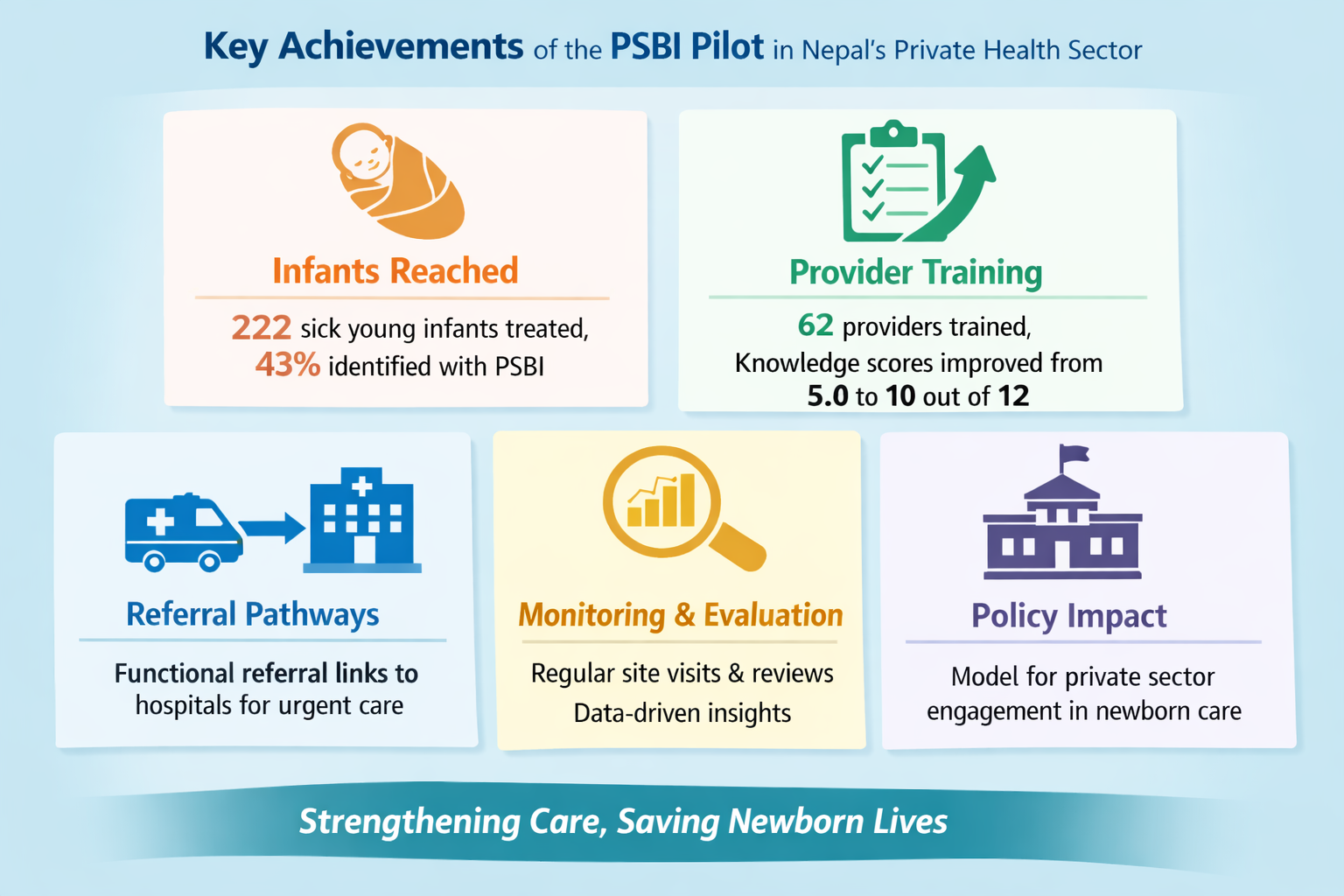
The pilot program delivered measurable improvements in the management of neonatal infections within Nepal’s private health sector. Over the nine‑month implementation period, 222 sick young infants were reported, with nearly half identified as PSBI cases. For the first time, private providers systematically documented assessments, treatments, referrals, and follow‑ups using standardized registers and referral slips, laying the foundation for stronger accountability and data‑driven decision making.
Training and capacity‑building efforts proved highly effective. Providers’ knowledge scores rose dramatically, with average test results increasing from 5.6 to 10 out of 12 following training, and further gains observed during refresher workshops. Equipped with essential diagnostic tools, providers were better prepared to identify danger signs and initiate appropriate treatment or referral.
The program also strengthened referral pathways by linking medicine shops and clinics directly with Dhulikhel Hospital physicians. This innovation enabled timely consultations and improved coordination between frontline providers and tertiary care facilities, ensuring critically ill infants received lifesaving care.
Robust monitoring and evaluation mechanisms captured progress and highlighted areas for improvement. Monthly visits, joint reviews by the Technical Advisory Group, and observational interviews provided valuable insights into provider practices and client perceptions. These findings informed adaptive changes during implementation and generated evidence for national policy dialogue.
Perhaps most importantly, the pilot demonstrated the feasibility of engaging the private sector in neonatal infection management. By combining training, equipment provision, referral linkages, and stakeholder collaboration, the initiative created a replicable model that can be scaled across districts. The lessons learned now inform policy recommendations for regulating private providers, updating PSBI protocols, and designing comprehensive interventions to reduce neonatal mortality nationwide.
The pilot program demonstrated that engaging Nepal’s private health sector in the management of neonatal infections is both feasible and transformative. By combining provider training, essential diagnostic equipment, strengthened referral systems, and multi‑stakeholder collaboration, the initiative improved the capacity of frontline providers, enhanced accountability, and established a scalable model for reducing newborn deaths nationwide.

